Galaxy Clusters
The main component of my thesis research is studying the mass content of galaxy clusters. This can be done primarily in two ways: gravitational lensing and galaxy dynamics. These two methods come with many assumptions (e.g., clusters are in hydrostatic equilibrium), however, in my thesis I am aiming to combine these methods to minimize the effects of these biases on scientific results. In particular, I aim to better understand the nature of dark matter by combining these methodologies.
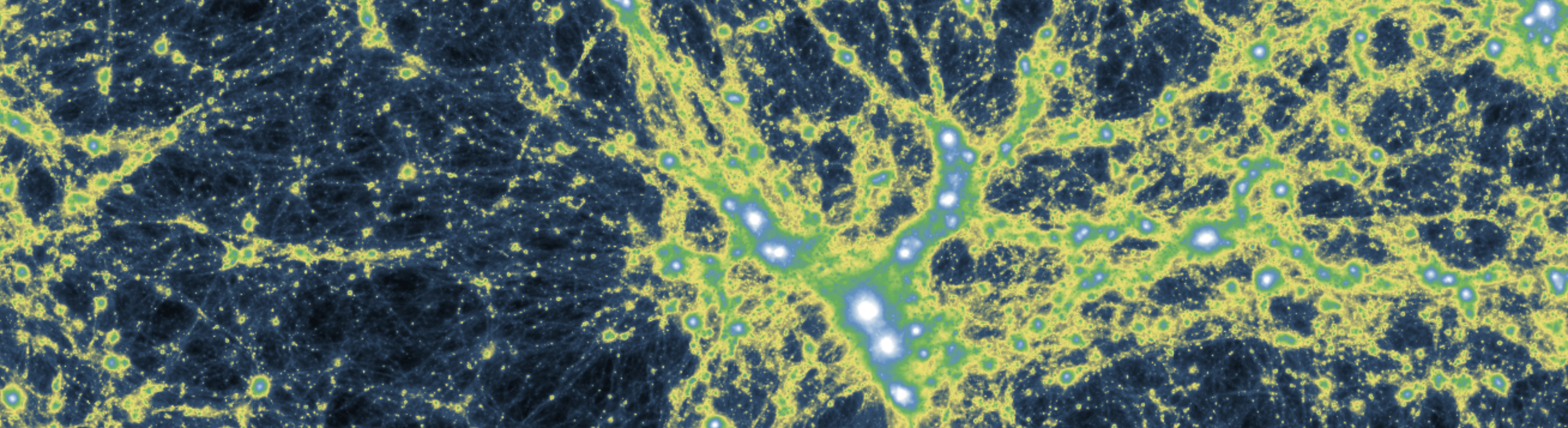
To begin to chip away at this seemingly intractable problem, I am studying the dynamics of cluster-member galaxies inside of cosmological simulations (e.g., IllustrisTNG simulation, pictured above). In particular, their membership in dark matter substructure and how these cluster-member galaxies interact with baryonic gas in the intracluster medium. Developing understanding about dark matter substructure and how it moves relative to baryonic matter will place constraints on how much dark matter can interact with itself. My current research aims at detecting signatures of self-interacting dark matter in cosmological simulations and how we can use cluster-member galaxies to make fewer assumptions when building a dark matter mass map using gravitational weak lensing. You can learn more about this research at the project's GitHub page.